
11 min read
Last updated
Employee representation when running an organisation across multiple European countries can become more complex than many employers expect. Multinational organisations often need to navigate two distinct consultation frameworks at the same time: the European Works Council (EWC) and the Dutch Works Council (OR).
While both councils represent employees, they serve different purposes, operate at different levels, and are governed by separate legal frameworks. Understanding how they interact is essential for effective employee representation, HR governance and compliance.
In short, the EWC focuses on transnational issues affecting employees across multiple European countries, whereas the Dutch Works Council deals with matters at the national or local level within the Netherlands. In many multinational organisations, both bodies exist side by side, each with its own rights, responsibilities, and consultation processes.
Employee representation is essential in every work environment in the Netherlands. The Dutch Works Councils Act defines the rules relating to staff representation. In this article we explain the difference of the Works Council EU versus the Works Council Netherlands.
AT A GLANCE
European Works Council (EWC) Legislation
The European Works Council (EWC) was established as a result of the economic and political integration of the European Union in multinational company affairs. As companies become transnational, local councils lacked a direct connection to the level on which the real decisions are taken.
It was developed in the 1980s through informal contacts between workers’ representatives from different European countries. The bodies soon proved to be able to cater for the information and the consultation needs of the employees and the company management.
European Works Councils were first introduced through EU legislation in 1994. The framework was revised in 2009 and amended again in 2025 through Directive (EU) 2025/2450. The main framework remains Directive 2009/38/EC, as amended. Employment, Social Affairs and Inclusion.
The latest changes strengthen the EWC’s role by:
- Clarifying which matters are considered transnational.
- Requiring management to consider the EWC’s opinion and provide a written response before taking a decision.
- Setting clearer conditions for withholding information or treating it as confidential.
- Removing exemptions for certain older agreements.
- Strengthening access to justice and penalties for breaches. Employment, Social Affairs and Inclusion.
The amending directive entered into force on December 31, 2025, but its requirements have a phased timetable:
- By January 1, 2028: EU members states must update their laws. Each EU country must put the new EWC rules into its national legislation and publish those changes.
- From January 2, 2028: the transition for existing agreements begins. Exemptions for certain older agreements are removed, and procedures to bring existing EWC agreements into line with the revised rules become available. This does not mean every agreement must be rewritten by that date.
- From January 2, 2029: most new rules start to apply. Employers and EWCs must follow the strengthened requirements, subject to the specific transition arrangements for existing agreements.
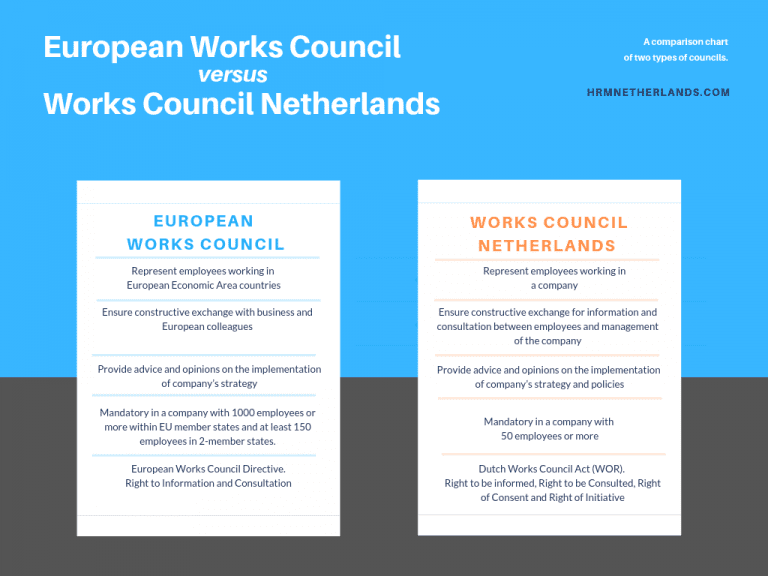
The EWC represents employees working in European Economic Area countries and is mandatory in a company with 1000 employees or more within the EU member states and at least 150 employees in at least 2 member states.
Works Council Netherlands
The Work Council in the Netherlands enables employees to protect their position while looking after the interests of the company. It offers the employer with tools through which they can obtain more support for their decisions and allow employees to influence the decisions made by the company. The rules concerning staff representation are described in the Dutch Works Councils Act (Wet op de ondernemingsraden, WOR).
The purpose of a Works Council is to benefit both the employer and employees, through both representations in the workplace and a having a forum in which constructive feedback can allow the business to progress. The Works Council’s rights and interests are solely intended to protect employees in the working environment.
The correct English term for the Ondernemingsraad in the Netherlands, is Works Council, not Workers Council. A Works Council is mandatory in the Netherlands if the organisation employs at least 50 workers. An organisation with multiple legal entities in the Netherlands and each entity is exceeding the 50-employee threshold, will have to establish a council per legal entity.
The Work Council’s rights and responsibilities in the Netherlands are solely intended to protect employees in the working environment. The main rights of the Dutch Works Council include:
- Right to be Consulted / Right of Advice article 25 and article 30 of the Works Councils Act.
- Right of Consent / Right of Approval article 27 of the Works Councils Act.
- Right for Initiative article 23 of the Works Councils Act.
- Right to be Informed article 31 of the Works Councils Act.
Structural Differences Between the Two Bodies
The most fundamental difference between the Works Council Netherlands and the European Works Council is scope. The Dutch Works Council is established under the Dutch Works Councils Act (WOR) and represents employees within a specific Dutch company or business unit. It focuses on decisions affecting that organisation locally, from restructuring to working conditions to major financial changes.
The European Works Council, on the other hand, is governed by the EU EWC Directive and applies to companies with at least 1,000 employees across EU member states and at least 150 employees in each of two or more member states.
It operates at the transnational level, meaning the European Works Council only deals with matters that affect employees across multiple countries.
| Aspect | Netherlands Works Council (OR) | European Works Council (EWC) |
|---|---|---|
| Legal basis | Dutch Works Councils Act (WOR) | EU Directive 2009/38/EC |
| Establishment requirement | Mandatory for an undertaking with at least 50 employees | Applies when specific workforce and cross-border thresholds are met |
| Scope | Matters concerning the Dutch undertaking | Transnational matters affecting employees across participating countries |
| Membership | Elected by employees of the Dutch undertaking | Employee representatives from participating countries, selected according to applicable national rules |
| Meeting frequency | Meets regularly throughout the year | Typically meets once or twice a year, with additional meetings where required |
In summary the Works Council Netherlands is responsible for the Dutch legal entity operation, the European Works Council zooms out across the organisation’s legal entities in Europe. Both have legal weight, but the rights, responsibilities, composition, and decision-making scope are different.
The Rights of the Dutch Works Council vs. European Works Council
The Dutch Works Council and the European Works Council both have a right to information and consultation. Their role in a decision-making process is different.
Under the Dutch Works Councils Act (WOR), the Dutch Works Council has several rights:
-
Right of Advice, Articles 25 and 30 WOR
Management of an organisation must ask the Dutch Works Council for advice before taking certain decisions, while there is still time to influence the outcome.
- Article 25 covers major business decisions, such as a restructuring, merger, closure or significant investment.
- Article 30 covers the appointment or dismissal of the person who leads the undertaking (bestuurder under the WOR).
The Works Council reviews the proposal, asks questions and gives its advice. Management can decide differently, but must explain why. Advice is therefore more than asking for feedback, although it does not mean the Works Council must approve the decision.
-
Right of Consent, Article 27 WOR
Management needs the Dutch Works Council’s consent before introducing, changing or withdrawing certain employee policies or systems. Examples include arrangements for:
- Working hours and annual leave.
- Performance Management cycle.
- Health and safety, sickness absence and reintegration.
- Employee privacy and monitoring.
This right concerns arrangements applying to all employees or a group of employees. It does not cover every HR decision. If the Works Council refuses consent, management must obtain permission from the subdistrict court before proceeding.
-
Right of Initiative, Article 23 WOR
The Dutch Works Council can put forward its own proposals without waiting for management to act. For example, it could propose improvements to workload, communication or the way work is organised. Management must discuss the proposals with the Works Council at least once. It must then respond in writing, explaining whether it accepts the proposal and why. Management does not have to accept it, but it must give it proper consideration.
-
Right to Information, Article 31 WOR
The Works Council in the Netherlands is entitled to the information it reasonably needs to carry out its duties. It can ask management for information to understand a proposal, assess its consequences and prepare its response. This could include relevant financial figures, organisational plans or HR data (number of employees, hires, leavers etc.).
Rights of the European Works Council
-
Right to Information
Management must give the EWC the information it needs to understand a transnational matter and assess its impact on employees. This could concern a restructuring, merger or planned closure with consequences across countries. The information must be provided early enough, and with enough detail, for employee representatives to prepare for consultation. Simply announcing a decision does not fulfil this purpose.
-
Right to Consultation
The EWC must have an opportunity to discuss the proposal with management and give its opinion while that opinion can still influence the decision. Consultation allows the EWC to:
- Ask questions about the proposal.
- Raise concerns about its consequences for employees.
- Suggest alternatives or measures to reduce the impact.
The 2025 amendment of the European Works Council Directive, strengthens this process: management must consider the EWC’s opinion and respond in writing before taking the decision.
The EWC does not have the same statutory right to approve certain employee policies as a Dutch Works Council has under Article 27 WOR.
The main rights of the European Works Council is information and consultation on transnational matters. The EWC agreement sets out the practical arrangements and may provide additional rights. Consulting the EWC does not replace any advice or consent procedure required at national level. Management will still have to consult with the Dutch Works Council as well.
Support in Works Council Compliance
Human in Progress provides Works Council advice, coaching and training. We support your organisation and Works Council:
- Understand the Dutch Works Councils Act: which rights apply and what they mean for your situation.
- Prepare for consultation: review proposals, identify questions and prepare for discussions with management or the Works Council.
- Work through change: receive advice on the Works Council’s role in a restructuring or other organisational changes.
- Improve ways of working: establish practical meeting arrangements, responsibilities and communication.
- Build knowledge and skills: through the Human in Progress Academy, with separate training for Works Council members and for employers, HR and leadership.
Contact Human in Progress to connect and receive the answers to your questions and the support you need.
Frequently Asked Questions
Can a Dutch Works Council Member also Serve on the European Works Council?
Yes. A member of the Dutch Works Council can also serve on the EWC, provided they are selected through the applicable appointment procedure. In the Netherlands, the central, group or local Works Council usually selects the Dutch EWC representatives.
In many organisations, Dutch employee representatives sit on both the Dutch Works Council and the EWC. It is important to keep the roles formally separate, as each body operates under different legal frameworks, has different mandates, and each council must follow its own procedures independently.
How Do you Determine if a Proposed Decision Requires Consultation with the Dutch Works Council, the EWC or both?
Check the rights of each body separately:
- Dutch Works Council: Does the proposal concern the Dutch undertaking and fall within its rights under the WOR? Major business decisions may require advice under Article 25, while certain employee policies require consent under Article 27. A proposal originating at international headquarters can still trigger Dutch Works Council rights.
- EWC: Is the matter transnational and within the EWC’s information and consultation remit? Consider its potential effects across countries, the management level involved and the EWC agreement. A matter can have a transnational character even if its immediate impact appears concentrated in one country.
- Both: A European restructuring affecting the Dutch organisation may require EWC consultation alongside a Dutch right of advice consultation.
Does Consultation with the EWC Replace Consultation with the Dutch Works Council?
No. Each body has its own role and rights. The EWC addresses transnational matters, while the Dutch Works Council exercises its rights under the Dutch Works Councils Act (WOR).
If a proposal falls within both bodies’ remit, management must follow both processes. Completing EWC consultation does not remove the obligation to request advice or consent from the Dutch Works Council where required.
More Information
- Human in Progress Academy: Works Council Courses
- What Is a Works Council Netherlands Under Dutch Law?
- Works Council Netherlands Rights & Responsibilities.
- Works Council Services Solutions